

TECHNOLOGY
How Re-Du works
Re-Du's process uses a selective organocatalyst, originally developed at Oak Ridge National Laboratory and licensed to Re-Du. It breaks PET down into BHET using commercially available process equipment. Everything that isn't PET is filtered out as a solid.
WHAT WE’VE TESTED
Tested on real waste, not just clean bottles
In the lab, we have converted more than 10 real-world PET waste streams to BHET, including adhesive-backed and multilayer industrial film, colored and opaque bottles with caps and labels on, polyester and poly-cotton textiles, PET-rich post-consumer carpet, and unwashed ocean-collected plastic.
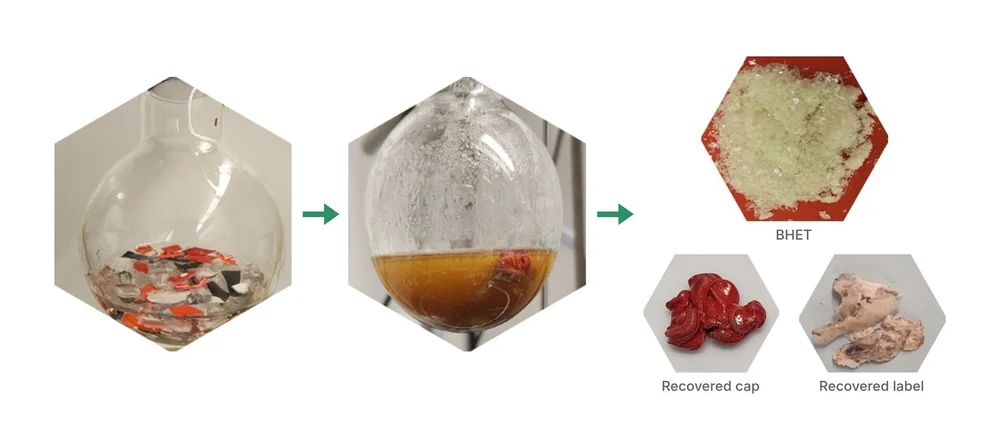
Bottle, cap and label go in together
The PET becomes BHET; the cap and label come out intact.
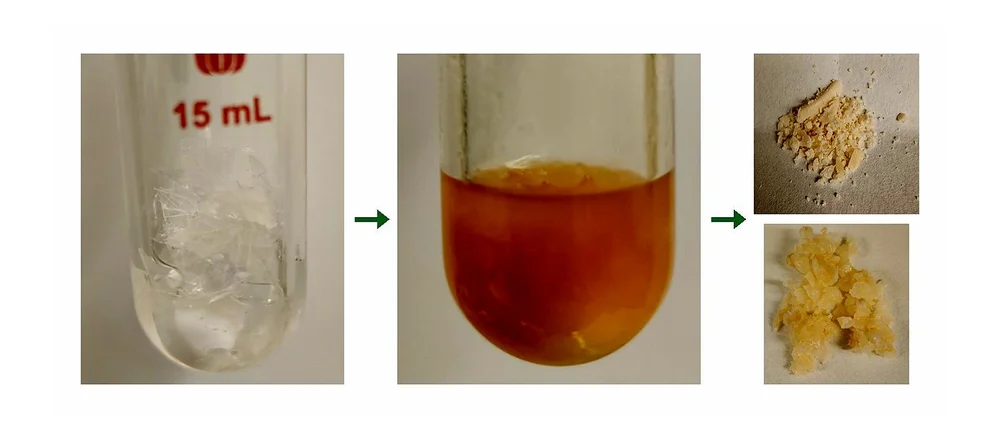
Adhesive-backed multilayer film
The PET converts to BHET and the adhesive is recovered separately.
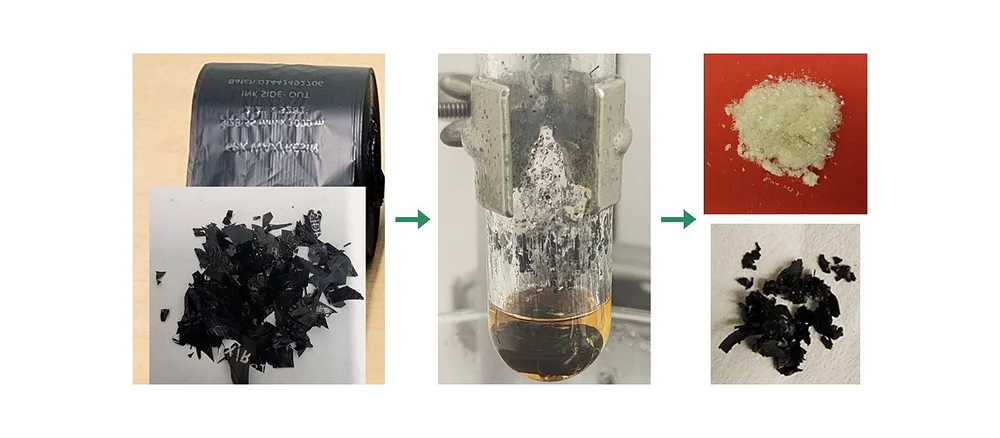
Used printer ribbon film
The PET converts to BHET and the black coating is left behind.
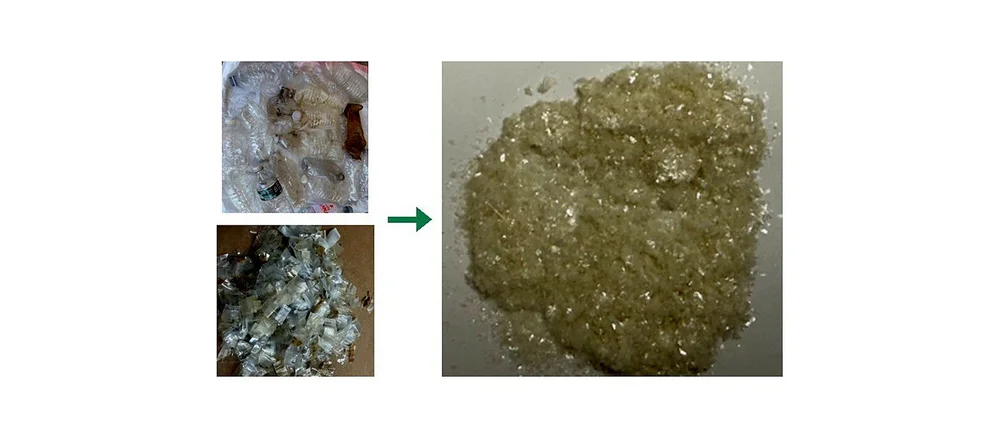
Unwashed ocean-collected plastic
Converted to BHET without washing first.
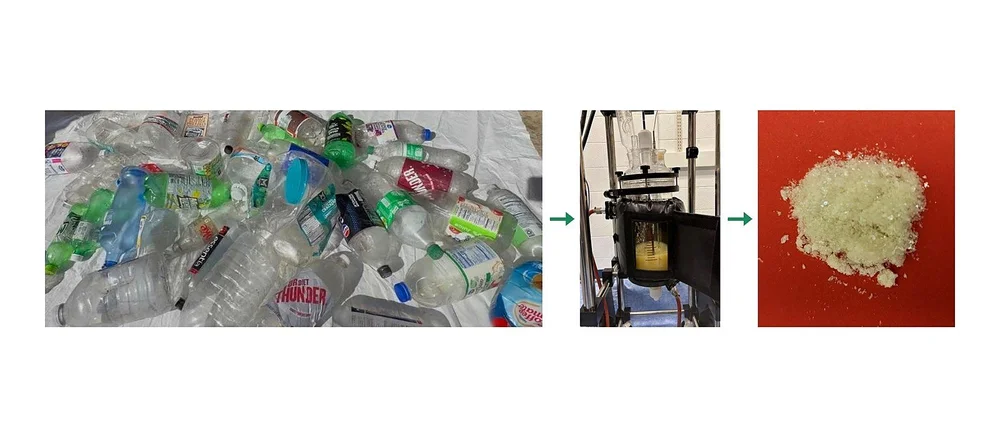
Mixed bottles in a 5-liter reactor
Mixed post-consumer bottles processed at bench scale.
All photos show laboratory and bench-scale work. Pilot campaigns will confirm performance on variable industrial feed over sustained operation.
Our second market · Carpet
Carpet: only the PET reacts
Most carpet fiber is PET, but it is tangled up with polypropylene backing, adhesives, fillers and salts. Mechanical recycling can't untangle it, so almost all old carpet is landfilled. Our catalyst breaks down only the PET and leaves the rest behind to be recovered.
2–3.5 Mt
of post-consumer carpet discarded in the U.S. every year
~94%
of that carpet is landfilled today
5% by 2028
carpet-derived recycled content required in California; bottle PET doesn't count
Sources: ORNL TCF technical volume (2024); CARE 2025 California report; California AB 863.
From old carpet to W2V™ Monomer
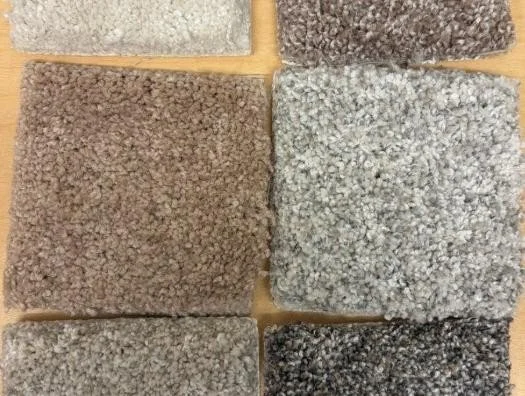
Post-consumer carpet, about 80–85% PET.
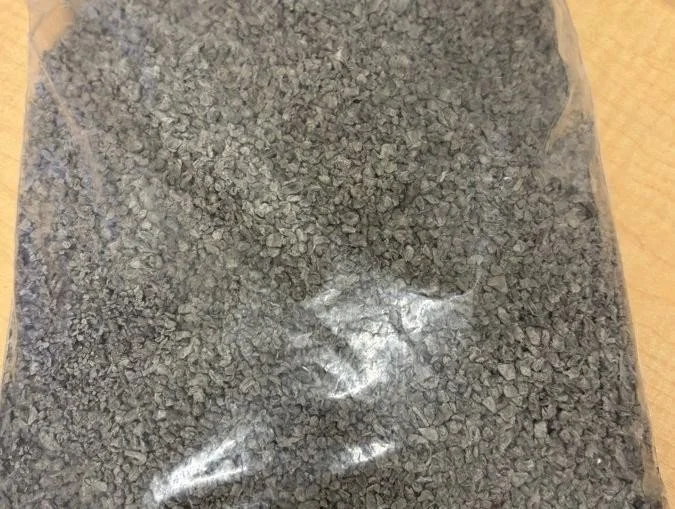
Shredded, with backing and fillers still in it.
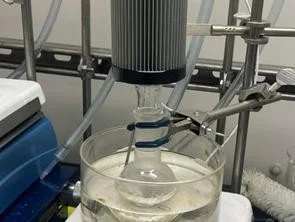
One catalyst, below 200 °C, at normal pressure.
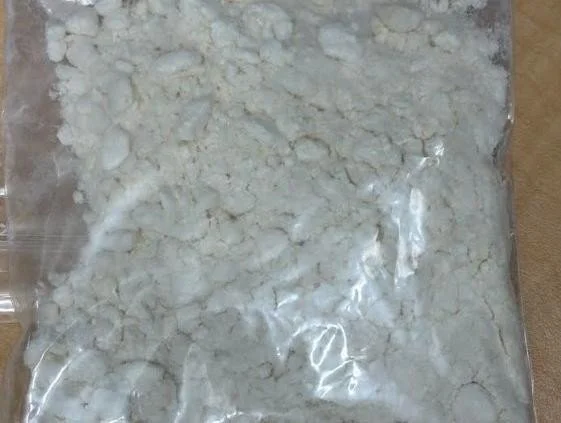
White W2V™ Monomer, ready to be made into new PET.
Laboratory results on real post-consumer carpet (about 80–85% PET, 10–15% PP/PE, ~5% backing, fillers and salts), run at 0.5 g, 5 g and 300 g. The BHET was made back into PET at gram scale and compared with commercial PET. Work with Oak Ridge National Laboratory under a DOE Technology Commercialization Fund project.
Scaling carpet up
Real carpet at 0.5, 5 and 300 g; ~90% BHET yield.
500 g–1 kg batches in a 5 L reactor, with purification and cost analysis alongside ORNL.
Bench validation, up to 5 kg of dry carpet per batch.
Pre-pilot unit operations, about 0.5 dry tonnes per day.
First regional plant at a carpet collection hub.
Work with us on carpet
We're looking for partners across the carpet loop:
- Collectors and recyclers with PET carpet to test
- Carpet makers who need carpet-derived recycled content
- PET producers to qualify carpet-derived BHET
Development stage
Where we are
- 1
Today
Lab and bench scale
The process is validated at laboratory and bench scale on more than 10 real-world PET waste streams.
- 2
Planned 2027–2028
30-tonne-per-year pilot
A pilot running on industrial waste.
- 3
Commercial design
~10,000 tonnes per year, regional
A modular regional plant built near the waste it processes.
Beyond PET
A platform for other polymers
The same catalyst family can deconstruct other condensation polymers by changing reaction conditions.
PET is our focus now; the others are longer-term extensions.
Send us a sample
If your operation produces PET waste that has no recycling outlet, we would like to test it.